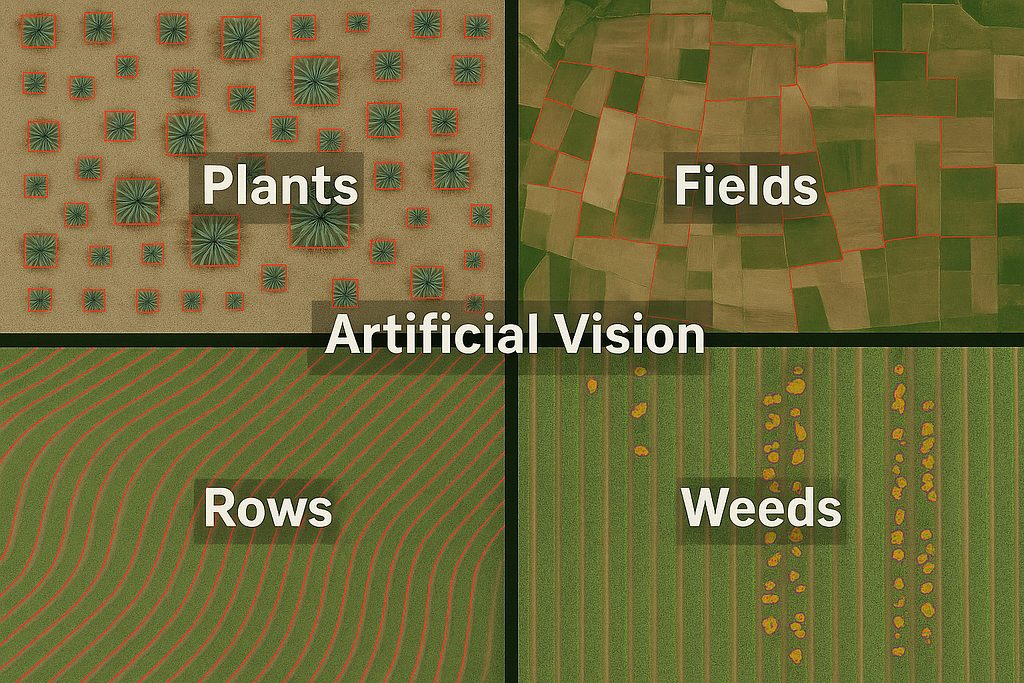
Explaining what computer vision means in agriculture isn't always easy. To make it clearer, let's think about its most common uses:
- Pest and disease detection
- Plant counting and classification
- Anomaly and variability detection
- Identifying planted areas
- Reconstructing planting patterns
The easiest way to understand the technical side is to imagine we're chatting with an AI.
To classify, we can ask: which of these two plants is healthy, and which is sick?
To count and locate, the question would be: how many plants are in the image, and where are they?
Finally, to outline shapes, we can ask questions like: what polygons can be seen in this image? Which planting patterns stand out? What are the outlines of the leaves and the weeds?
Computer vision models don't behave like AI chats, but they do the same job: answer specific questions precisely.
Every well-posed question opens the door to a better decision. That's the promise of AI in agriculture: turning complex data into clear actions.